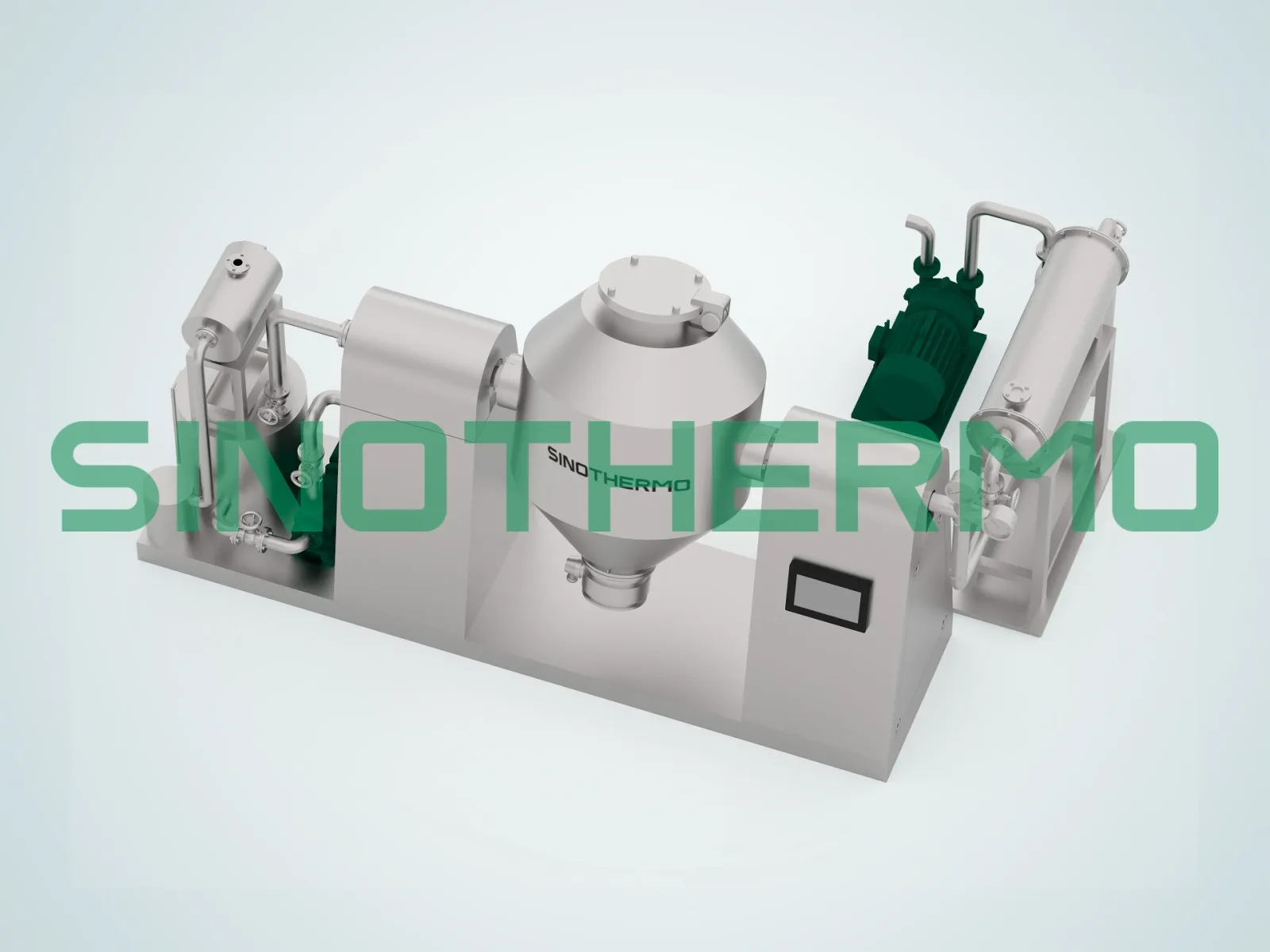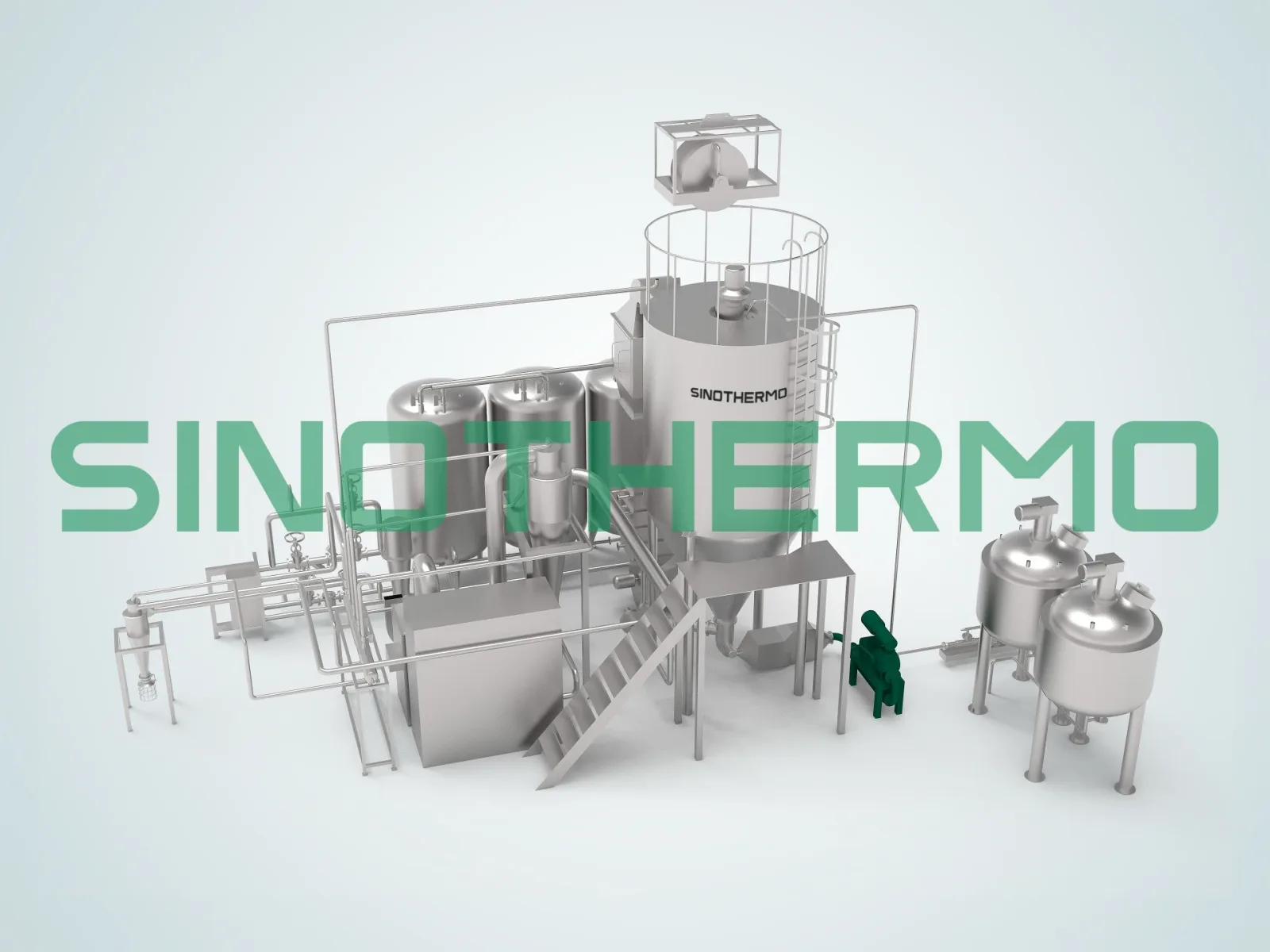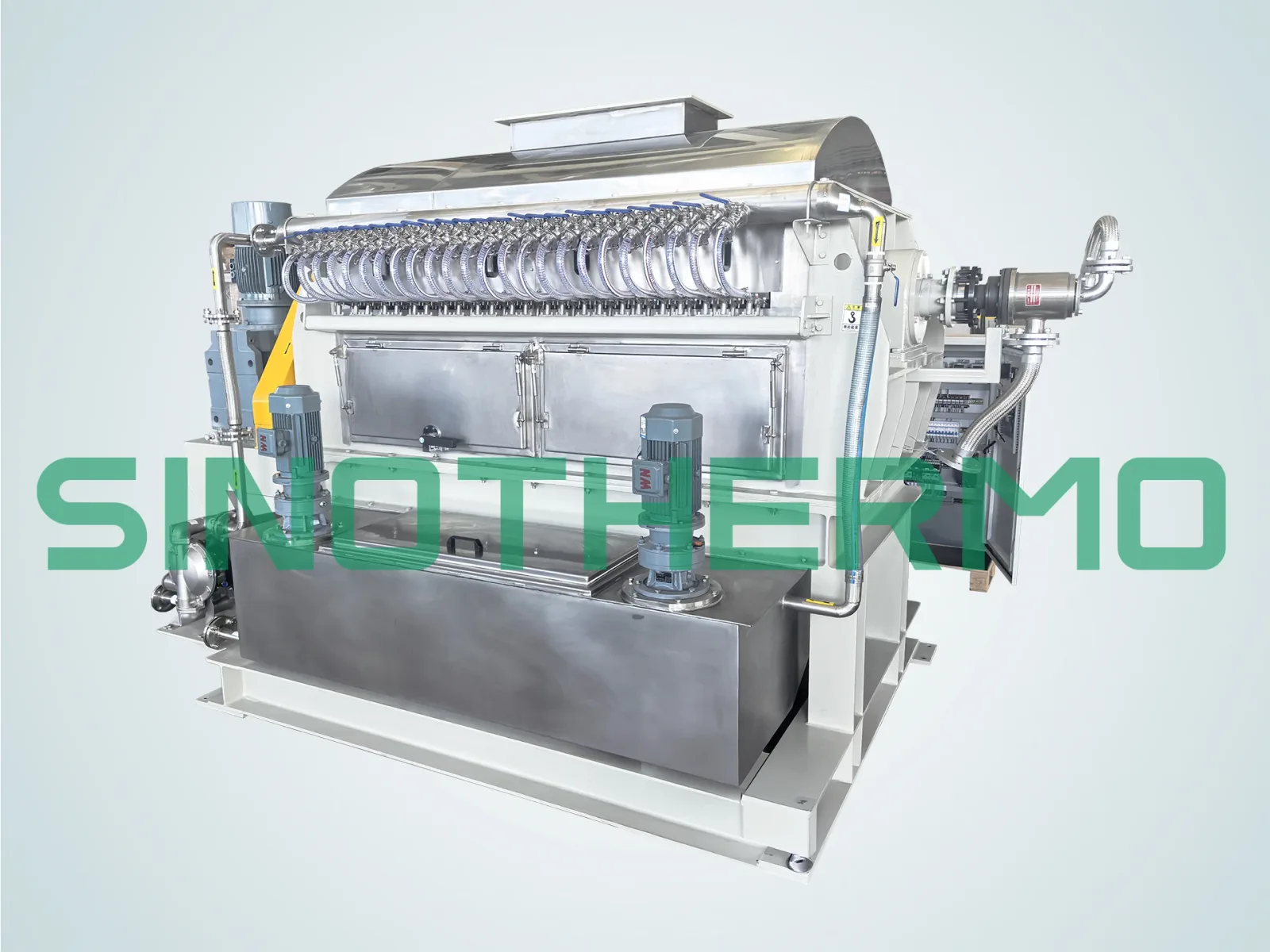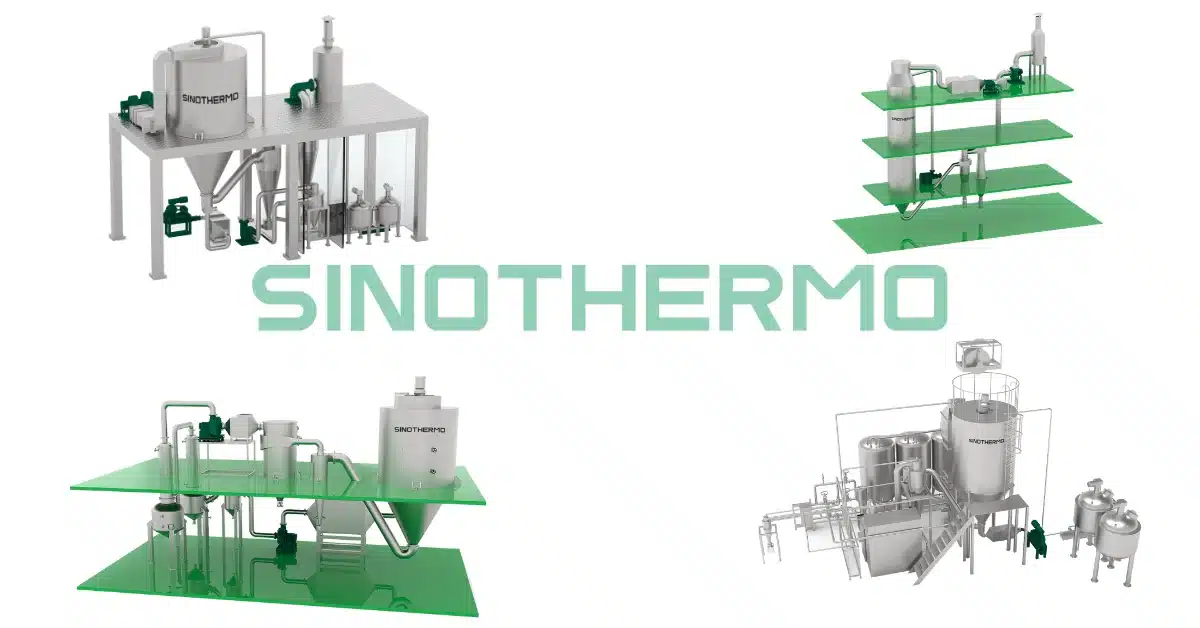
A spray dryer machine turns a liquid feed such as a solution, emulsion or slurry into dry powder in one continuous step by atomising it into hot gas. Four designs cover most industrial needs: centrifugal (rotary), pressure nozzle, extract (cooled-wall) and closed circulation. The right one depends on your feed, the powder you need and the scale you work at, and the price depends mostly on evaporation capacity.
Buying a spray dryer is a configuration decision, not a catalogue pick. Two machines of the same tower height can remove very different amounts of water, and two quotations for "a 100 kg/h spray dryer" can differ by a factor of two because of what each includes. This guide explains the four machine types with real SINOTHERMO model ranges, the three scales, what drives price, and a six-step method for choosing.
Quick Context: what a spray dryer machine does
Every spray dryer has the same four jobs: atomise the feed into fine droplets, mix those droplets with hot gas, evaporate the water in seconds, and separate the powder from the exhaust. The differences between machines come from how each job is done. For the underlying physics see how spray drying works, and for where spray drying sits among other technologies see how to choose an industrial dryer.
Spray Dryer Machine Models at a Glance
| Machine type | SINOTHERMO series | Water evaporation | Inlet air | Best for |
|---|---|---|---|---|
| Centrifugal spray dryer | LPG | 25 to 2,000 kg/h | 150 to 500 °C | Fine, uniform powder; tolerates changing viscosity |
| Pressure spray dryer | YPG | 50 to 1,000 kg/h | 140 to 350 °C | Coarse, dense, free-flowing granules |
| Closed circulation spray dryer | GXP | see product page | 100 to 300 °C | Organic solvents, flammable or oxygen-sensitive feeds |
| Extract spray dryer | ZLPG | see product page | 140 to 180 °C | Sticky, heat-sensitive extracts |
Model pages: Centrifugal spray dryer, Pressure spray dryer, Closed circulation spray dryer and Extract spray dryer.
Every spray dryer machine is sized by water evaporation, not by powder output. See spray dryer sizing for the method, or compare all models on the spray dryer page.
The four types of spray dryer machine
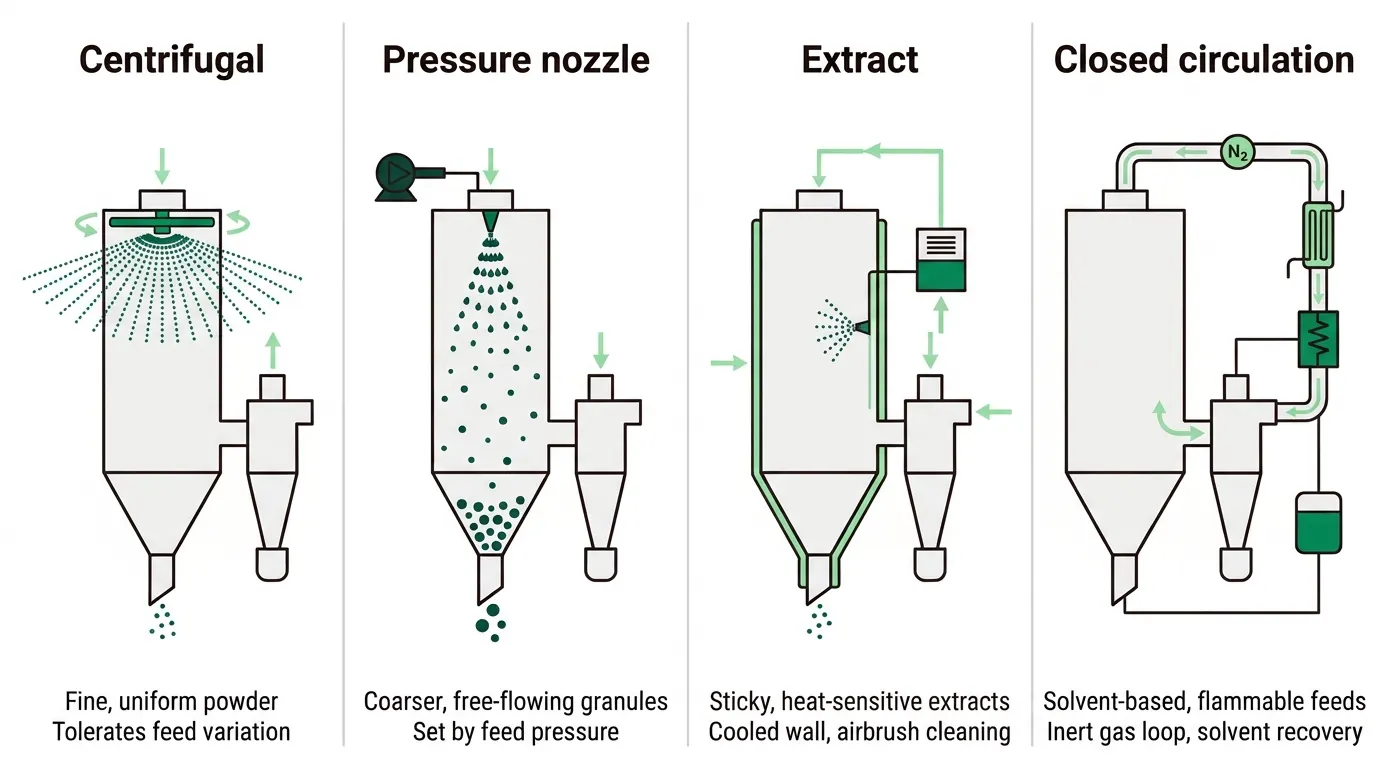
1. Centrifugal (rotary) spray dryer
A high-speed spinning disc throws the feed outward into a uniform droplet cloud. Because droplet size is set by disc speed rather than feed pressure, a rotary atomiser keeps producing consistent powder even when feed viscosity or solids content drifts. It is the usual choice for fine, uniform powders such as milk powder, ceramics, catalysts and cosmetic ingredients. SINOTHERMO's centrifugal spray dryer is the LPG series, from the LPG-25 (up to 25 kg/h evaporation) through the LPG-50 and LPG-150 to the LPG-200-2000 range (200 to 2,000 kg/h). Inlet temperature is 150 to 500 °C with outlet around 80 to 90 °C, and dry powder recovery is 95 percent or more.
2. Pressure nozzle spray dryer
A high-pressure pump forces the feed through a nozzle at the top of the tower. This gives coarser, denser, more free-flowing granules and suits applications where granule size and flow matter more than very fine particles, such as ceramic granules and some chemical products. The pressure spray dryer is the YPG series, from the YPG-50 (50 kg/h evaporation) to the YPG-1000 (1,000 kg/h), with pump pressure of 2 to 10 MPa, inlet air of 150 to 350 °C, product moisture below 5 percent (can reach 0.5 percent) and material recovery above 97 percent.
3. Extract spray dryer
Extracts, flavours and similar feeds are sticky and heat-sensitive, and they burn on hot walls. The extract spray dryer (ZLPG series) is built around that problem: a cylinder cooling system keeps the tower wall below 80 °C, an airbrush system cleans the wall during operation, and freeze dehumidification stabilises drying in humid air. It works at a 140 to 180 °C inlet and delivers powder at 3 to 8 percent moisture. For a deeper look, read spray drying herbal and plant extracts.
4. Closed circulation spray dryer
When the feed contains an organic solvent, or the product is flammable, oxygen-sensitive or toxic, an open-cycle tower that vents to atmosphere is unsafe. The closed circulation spray dryer (GXP series) runs on inert gas, usually nitrogen, in a sealed loop; the solvent is condensed and recovered and the gas is reheated and reused. Inlet range is 100 to 300 °C with powder at 3 to 8 percent moisture. See closed loop spray dryer: nitrogen loop and solvent recovery for the full explanation.
| Type | Atomiser | Powder character | Evaporation range (kg/h) | Best for |
|---|---|---|---|---|
| Centrifugal (LPG) | Spinning disc | Fine, uniform; tolerates feed variation | 25 to 2,000 | Milk, ceramics, catalysts, cosmetics |
| Pressure nozzle (YPG) | High-pressure nozzle | Coarser, dense, free-flowing granules | 50 to 1,000 | Granules, ceramics, chemicals |
| Extract (ZLPG) | Nozzle, cooled wall | Extract powder, low wall burn | See product page | Herbal and food extracts, sticky feeds |
| Closed circulation (GXP) | Nozzle or disc, inert loop | Powder dried under inert gas | See product page | Solvent-based, flammable, oxygen-sensitive feeds |
Capacity figures are maximum values and depend on the material and on inlet and outlet temperatures. Confirm the current specification when you request a quotation.
Choosing the scale: lab, pilot and industrial
A spray dryer machine is bought at one of three scales, and confusing them is a common way to waste budget.
Lab spray dryer. Benchtop units process grams to a few kilograms per hour and answer feasibility questions during R&D. They show whether a material can be spray dried and roughly what powder to expect, but their geometry does not scale linearly, so lab data alone is not a production specification.
Pilot spray dryer. Pilot machines confirm parameters and product quality under conditions that transfer to production: inlet and outlet temperature, atomiser speed or nozzle pressure, feed concentration and residence time. Our pilot spray dryer guide explains what a pilot run should measure, and the standard PSD-5 and PSD-10 pilot spray dryers are listed there with full specifications.
Industrial spray dryer. Continuous production machines sized to a required tonnage, with the collection train, heat source and automation to run around the clock. Sizing is driven by evaporation capacity in kilograms of water per hour, not by tower dimensions.
SINOTHERMO supplies all three scales and runs pilot trials in its own testing lab, so parameters proven at pilot scale carry into the industrial build. For differences in scale, see lab vs pilot vs industrial spray dryer.
What drives spray dryer machine price?
There is no single spray dryer price, because the machine is configured to the application. Understanding the drivers lets you read a quotation and control cost.
- Evaporation capacity (kg water per hour) is the biggest lever. It sets tower size, air handling and heater duty, and so scales the whole machine.
- Materials of construction. Carbon steel is cheapest, 304 stainless is common for food, and 316L with sanitary finishes is expected for pharmaceutical work and raises cost substantially.
- Atomiser type. A rotary atomiser and a high-pressure nozzle system carry different capital and maintenance profiles.
- Heat source. Electric, steam, gas, fuel oil or hot air furnace, chosen against your site utilities and running cost. The available options depend on the model.
- Add-ons. Cyclone plus bag filter, a second-stage fluid bed, clean-in-place, explosion protection and PLC automation each add capability and cost. A second-stage fluid bed is a custom configuration rather than a standard feature: for an oil-rich plant material, for example, a line can spray dry first and then finish drying in a fluid bed, which removes the remaining moisture gently and gives a better-flowing powder. Whether it is worth adding depends on the material, so we confirm it by trial.
- Compliance. CE, GMP and ATEX documentation and hardware raise the price but are non-negotiable in regulated markets.
For a fuller breakdown see our spray dryer cost guide, and for the used-equipment trade-offs read the used spray dryer buying guide.
How to choose a spray dryer machine: six steps
- 1.Define the feed. Solids content, viscosity, heat sensitivity and whether the solvent is aqueous or organic. Organic solvents force a closed-circulation design.
- 2.Set the powder specification. Particle size, bulk density, residual moisture and flowability. This is what the machine is designed to hit.
- 3.Pick the atomiser. Centrifugal for fine, uniform powder that tolerates feed variation; pressure nozzle for coarser free-flowing granules. See spray dryer atomization for the trade-offs.
- 4.Choose the scale. Lab and pilot for development, industrial sized by evaporation capacity.
- 5.Add compliance and options. GMP, CE, ATEX, CIP, second-stage fluid bed and heat recovery, matched to your market and utilities.
- 6.Validate with a pilot test. Confirm the recipe on your own feed before committing capital. Pilot testing is a paid service.
Common mistakes to avoid
Sizing by tower dimensions instead of evaporation capacity. Always specify kilograms of water per hour.
Scaling straight from lab to production. Skipping the pilot stage is how projects miss the powder specification after commissioning.
Comparing quotations without comparing scope. One supplier may include the cyclone, bag filter, fan, control panel and installation supervision and another may not. Ask for a line-by-line scope.
Under-specifying materials or explosion protection. Retrofitting stainless grade or ATEX hardware later costs far more than specifying it up front.
Ignoring operating cost. Heating dominates running cost. Ask for a utility sheet covering heat input, fan power and, where relevant, cooling water.
Choosing a standard machine for a sticky feed. Sticky extracts and sugar-rich feeds need cooled walls or other design measures. Read solving wall sticking in spray drying before you decide.
Conclusion
Pick the machine type from your feed, size it by evaporation capacity, and confirm the recipe with a pilot run before you buy. Four machine types cover most needs, and the price is shaped far more by capacity, materials and options than by the type itself.
Next step: Request a pilot test with your own feed. Pilot testing is a paid service, and the report gives you the parameters and powder properties needed for a firm specification and quotation.
FAQ
What is a spray dryer machine?
A spray dryer machine converts a liquid feed into dry powder by atomising it into hot gas, evaporating the water in seconds, and collecting the powder in a cyclone or bag filter. It runs continuously and is used in food, pharmaceutical, chemical and ceramic production.
Is a spray drying machine the same as a spray dryer?
Yes. Spray drying machine, spray dryer machine and spray dryer all describe the same equipment: a system that atomises a liquid into hot gas and collects the dry powder. Industrial suppliers usually say spray dryer.
How much does a spray dryer machine cost?
The price depends on evaporation capacity, materials of construction, atomiser type, heat source, add-ons and compliance requirements, so there is no single figure. A quotation needs your feed, capacity and standards. A pilot test is the fastest route to a firm specification.
Centrifugal vs pressure nozzle spray dryer: what is the difference?
A centrifugal machine uses a spinning disc and produces fine, uniform powder while tolerating feed variation. A pressure nozzle machine forces feed through a nozzle and produces coarser, denser, free-flowing granules. See the comparison table above.
Can a spray dryer scale from lab to production?
Yes, but not by direct multiplication. Heat and mass transfer geometry changes with size, so run a pilot trial that uses the same atomiser type as the production machine and take your scale-up parameters from that.
Which spray dryer is best for heat-sensitive or sticky extracts?
An extract spray dryer with cooled tower walls, airbrush wall cleaning and dehumidified air, operated at a moderate 140 to 180 °C inlet, is designed for that case. Add a carrier to the formulation if the extract is very sticky.
Which spray dryer should I use for organic solvent or flammable feeds?
A closed circulation spray dryer that recirculates nitrogen in a sealed loop and recovers the solvent in a condenser. An open-cycle machine is not suitable for flammable solvents.
What is the fastest way to get a firm quotation?
Send your feed details (solids content, viscosity, solvent), target capacity and powder specification, and consider a paid pilot trial. The trial removes the guesswork that otherwise leads suppliers to pad their numbers.

Mark Gu
Passionate about enhancing customer experiences and streamlining operations, Mark focuses on building strong relationships, fostering innovation, and leading teams to achieve exceptional service and efficiency.
Email: mark.gu@sinothermo.com
Phone: +86 18021972660